


Onboarding, also known as the process of introducing new employees to a company, is an important stage for anyone starting a new job. It helps the new employee adapt to the new work environment, learn about the culture and rules of the company, and establish relationships with future colleagues.
An effective onboarding process for new employees should include several basic steps:
- Workspace preparation: Make sure the new employee has everything they need to start work, including a computer, phone, documents, and other tools needed to perform their duties.
- Company introduction: It is essential to introduce the new employee to the company’s history, culture, structure, and its goals and mission.
- Assign a mentor: A mentor can help the new employee get oriented in the new work environment and answer questions about processes and procedures in the company.
- Define expectations: It is important to clearly define expectations for the new employee and help them understand their duties and responsibilities.
- Allow for networking: The new employee should have the opportunity to network with colleagues and learn about the team structure in which they will be working.
- Adaptation period: Do not expect the new employee to be fully productive right away. Ensure they have time to adapt to the new environment and learn their new responsibilities.
Onboarding new employees has many benefits, including:
- Faster integration: A well-organized onboarding process allows the new employee to quickly acclimate to their job and begin performing their duties.
- Increased efficiency: The new employee will know what is expected of them and what their duties are, which will enable them to perform their work better.
- Increased job satisfaction: Employees who go through an effective onboarding process feel more appreciated and more engaged in their work.
- Reduced employee turnover: A well-organized onboarding process can reduce employee turnover because new employees will be better prepared for their job and will be more motivated to stay in the company.
- Improved company image: An effective onboarding process can help improve the company’s image as a workplace, which will attract new, talented employees.
Considering the increasingly popular remote work model, it is important to remember to organize onboarding for new employees who will be working outside the company’s office, even in an online form. There are ways to conduct effective remote onboarding for employees.
Here are a few suggestions:
- Create an onboarding plan that takes into account the specific needs and expectations of the new employee. Make sure the plan includes information about the company, processes and procedures, as well as expectations for the employee.
- Organize virtual meetings with company employees so that the new employee can get to know colleagues. You can also arrange individual conversations with the supervisor and/or mentor to help the employee adapt to the new role.
- Provide the new employee with all necessary tools and materials, such as a computer, software, and company documents. Make sure they know how to use these tools and where to find information.
- Establish regular meetings with the new employee to monitor their progress and answer their questions and concerns. You can also organize online training or webinars to help them acquire the knowledge and skills needed to perform their new role.
- Encourage the new employee to make contacts and build relationships with other employees. Organize events or social gatherings to help the new employee feel like part of the team.
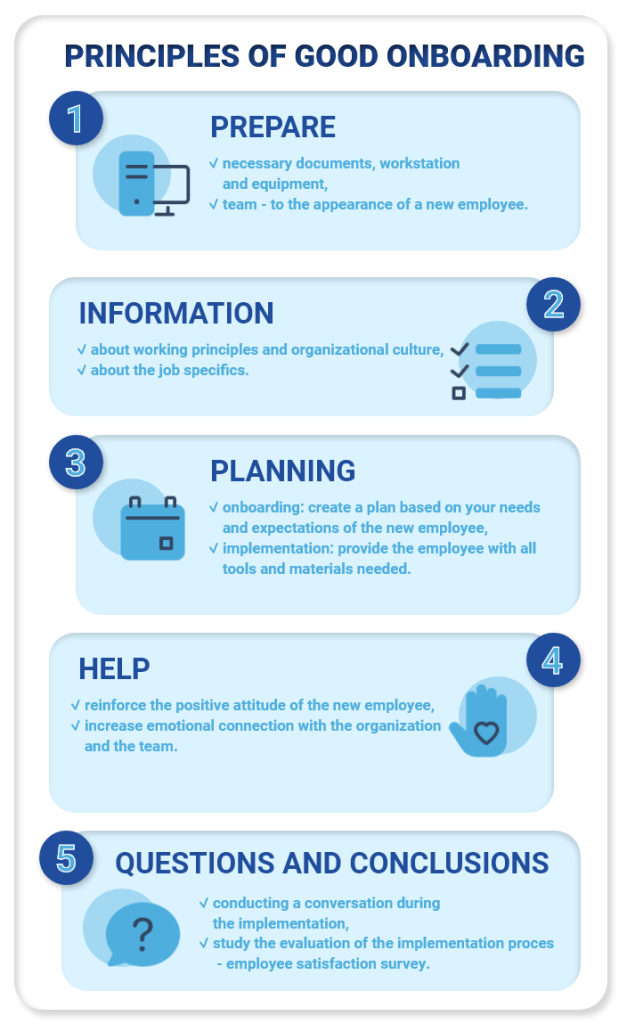
The first day in a new company is usually quite stressful for a person who is just getting to know their future colleagues and discovering a new work environment. It is important to ensure that the new employee’s workspace is properly adapted to their tasks. It is also essential to introduce the new employee to the team and answer their questions related to their new role.
A guide for the new employee can also be definitely helpful in the first days of onboarding. This is a collection of all the most important information that the newly hired person should know. Such a welcome package should include the following elements:
- Information about the company: a brief history of the company, its mission and goals, organizational structure, and information about the company’s culture and values.
- Rules and procedures: instructions regarding the company’s rules and procedures, e.g. regarding workplace safety, IT policy, or professional ethics.
- Building map: layout of the premises with markings of workstations, toilets, dining areas, and other amenities.
- Benefit information: additional benefits to the salary, such as sports cards, meal vouchers, or health insurance.
- Contacts: a list of phone numbers and emails for other employees, including a mentor or supervisor, as well as HR and IT departments.
- Work tips: instructions on how to use different tools and equipment, as well as special software.
In addition, increasingly, a welcome pack is prepared for the new employee, containing several functional gadgets such as a company notebook and pen, mug, and t-shirt with the company logo, which can be a nice gesture and a way to welcome the new person.
Onboarding helps new employees better understand the culture and goals of the company, as well as get to know the people they will be working with. It also helps new employees feel like important members of the team, whose work is valued in the organization. This increases the engagement of new employees and motivates them for further professional development. A well-conducted onboarding process can therefore help reduce turnover in a company, where employees feel like important members of the team and are less likely to seek another job.
